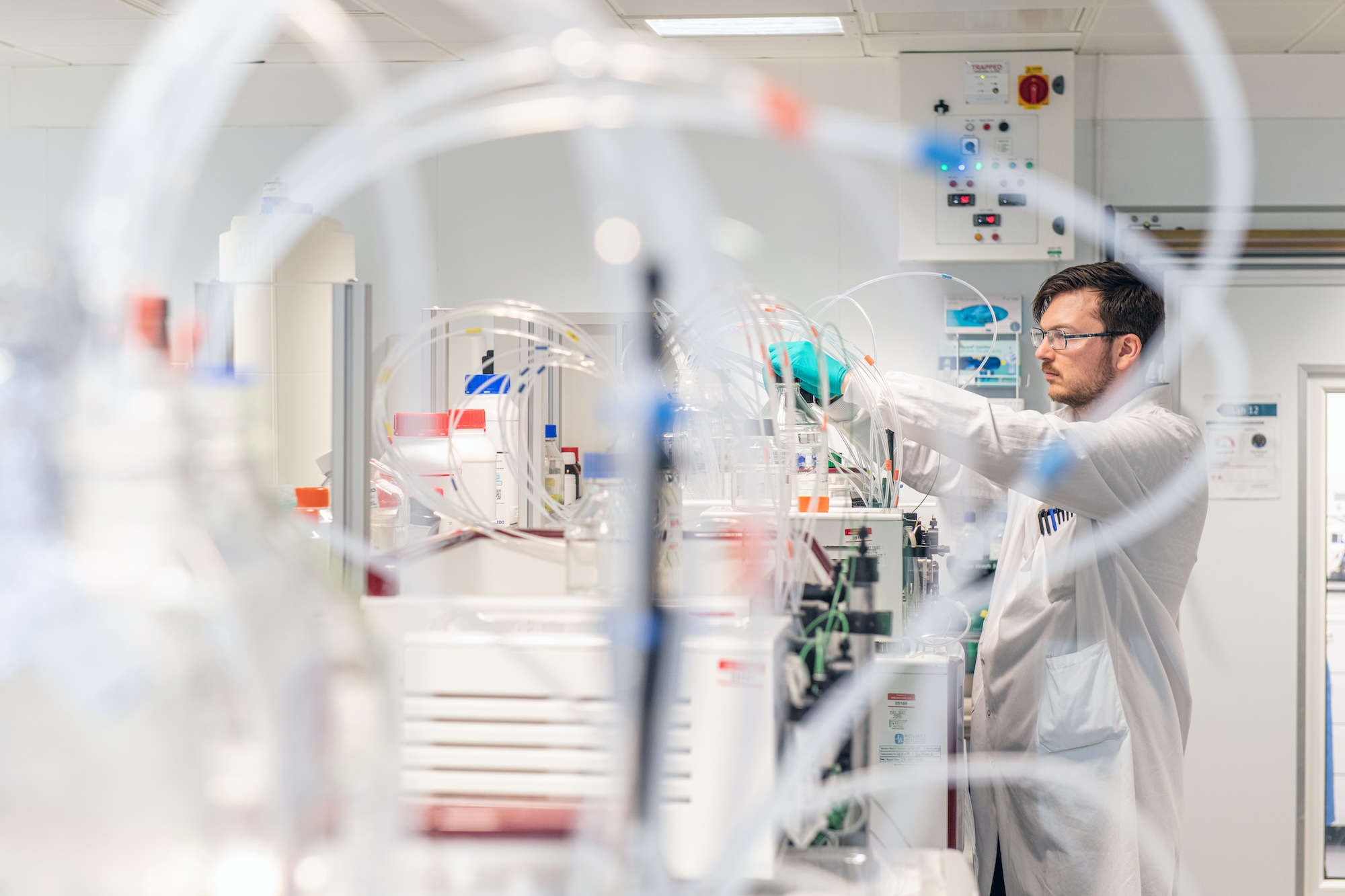
CMC: The science and engineering that turns molecules into medicines
by Kripa Ram, Chief Operating Officer
Biotechnology begins with a powerful idea: that a molecule can change the course of a disease. The journey from scientific promise to a medicine that’s available to patients involves several important stages, including pre-clinical research, clinical development, and approval from regulatory agencies. There is one equally crucial element throughout this journey that is sometimes misunderstood and other times considered a formality: making the medicine.
The science of ‘industrializing’ a biologic borne in a test tube in a research lab requires understanding the molecule, designing an optimal manufacturing process, producing it at a large scale, preserving it in a stable formulation, and testing it using sophisticated techniques to ensure quality.
This is where Chemistry, Manufacturing, and Controls – or CMC for short – comes in. Chemistry here stands for the methods used in manufacture of the product; Manufacturing refers to the actual manufacturing activity; and Controls refers to the various ways we ensure that a medicine is suitable for human use. At its core, CMC is responsible for turning molecules into medicines. It is both a technical discipline and a strategic capability for any biopharmaceutical company, connecting research, clinical development, quality, regulatory affairs, supply chain and commercial operations.
While Research teams ask whether a piece of science can combat a disease, CMC teams ask whether that science can be converted into an actual medicine that is stable, reliable, and convenient.
More than manufacturing
CMC is sometimes understood primarily through the lens of manufacturing. Manufacturing medicines to supply patients is undeniably the goal of all the CMC activities. But to deliver highest quality medicines to patients, CMC must:
- meet all the quality standards, including purity and potency
- provide sufficient shelf life (typically years) and a well-formulated product
- be able to meet the market demand with a scalable production process
- be cost-effective.
Very importantly, these scientifically challenging goals must be accomplished rapidly alongside clinical development to supply the necessary clinical trials and be ready for launch when the medicine is approved by regulators.
Given the breadth of activities encompassed, CMC is an amalgamation of scientists and engineers spanning several fields - from biochemists to biologists, from pharmacists to chemical engineers, from data scientists to statisticians.
Understanding a molecule
It should be noted that most modern medicines – whether synthetic (small molecules) or biologics (proteins) – are novel molecular entities that do not exist in nature. To meet the important targets of quality, scalability, stability and cost, one of the first things a CMC function needs to do – working with research scientists – is to thoroughly understand the characteristics of the molecule.
Such characteristics can include its molecular structure; its degradation characteristics when exposed to heat, light and acidic/basic environments; and other attributes that could affect its potency or safety. This knowledge is critical in guiding the work of process development and formulation development scientists, who use sophisticated analytical techniques to study the molecule’s size, shape and charge, which happen in parallel with quality control tests to ensure acceptability of a batch of medicine intended for human use.
Designing the manufacturing process
To manufacture large quantities of the medicine to be supplied to patients worldwide, in many cases multiple tons of the molecule must be manufactured. This requires the scientists and engineers to design a manufacturing process that consistently yields a large amount of product per batch, still meeting all the quality requirements.
In the case of biologic medicines, the protein – which is the core of the medicine – is developed in living cells (bacterial, yeast or mammalian cells). Cell and molecular biologists use advanced genetic engineering techniques to make these cells produce the protein efficiently. The actual manufacture involves growing these cells in bioreactors under optimal conditions to secrete the protein.
In addition to the protein we are interested in, the cells also produce several other proteins, and other cellular waste. Hence, the material harvested from the bioreactor is taken through several stages of purification to remove these impurities. The resulting bulk material containing the purified protein is referred to as Drug Substance. A cross-functional team comprising biologists, biochemists and chemical engineers work together to design a high-yielding, robust Drug Substance process in the lab that is later scaled-up to production scale.
Making it convenient for the patient
The product administered to the patient is referred to as the Drug Product, which can be a tablet or capsule in the case of a synthetic molecule, or, generally, a vial or syringe in the case of a biological product. The formulation team – composed of biochemists and pharmaceutical engineers – design a formulation that allows the medicine to maintain its structure, activity, and quality for years after manufacturing. For biologics, the formulation is typically a mixture of salts and sugars that ensure stability. This team is also responsible for developing convenient devices (e.g. auto-injectors) and the process for filling these devices with the formulated drug with high accuracy.
Scaling up
Translating the manufacturing process developed at the laboratory scale (from 0.1 to 10 liters) to a production scale (1,000 to 10,000 liters) requires significant engineering and digital expertise. A thorough understanding of the process, combined with scale-up engineering principles, helps recreate development-scale conditions at production scale.
Controls
Routine manufacturing of supplies to conduct clinical trials – as well as for commercial availability – brings the process, formulation, scale-up and analytical elements together. We need to ensure consistently rigorous quality controls are in place for the raw materials that go into the manufacturing process; for the facility environment in which manufacturing happens; for the qualification of the operator; validation of the computer systems that operate the equipment; and numerous other elements. Before a batch is released, there is a final quality control testing of the batch samples using several of the analytical techniques used during development.
Nature is not always predictable
The living cells which make our proteins – and the proteins themselves – are very sensitive to raw materials and environmental factors. Hence, despite the rigorous controls we have in place during manufacturing, unexpected issues can arise. The issue could be a trace level (in parts per billion) of a metal such as copper in a raw material lot that has an impact on the behavior of the cells, which in turn affects the production yield of a medicine. Or it could be a short temperature blip in a refrigerated truck carrying our medicine. A fair amount of time and effort from the CMC teams is spent applying their scientific expertise and the knowledge of the molecule and its development to troubleshoot and solve these issues to ensure high-quality medicines for patients.
Digital approaches are key to CMC success
Modern day drug development would not be possible without several digital technologies. A large number, potentially hundreds, of experiments can be done at once thanks to automation and robotics, while high-throughput analytics pipelines enable us to handle the resulting large volumes of data.
It is possible to produce batch after batch of high-quality medicines because of the digital process control of manufacturing equipment, which ensures that all the process parameters are always maintained strictly in range despite external disturbances. A combination of scientific understanding of the mechanism of biological/protein processes and advanced modelling and simulation allows us to gain much richer insights into our processes.
An evolving field is the application of Artificial Intelligence and Machine Learning in process development and manufacturing. This includes a drive to create ‘Digital Twins’ – a replica of the full-scale manufacturing process on the computer that allows us to predict process behavior in silico. Digital twins also have the potential one day to ensure that the resulting product is consistently of high quality, despite disturbances in any part of the long manufacturing process.
Building CMC as a strategic capability
For biotechnology companies to be successful long-term, CMC must be viewed as a strategic investment rather than a downstream requirement. The decisions made early in development can influence clinical timelines, capital needs, supply risk, regulatory readiness, and long-term commercial potential.
That does not mean every company should build a fully commercialized manufacturing infrastructure from day one. It means developing the right level of product and process knowledge at each stage, working closely with capable partners, and making choices with a clear view of the future.
The most effective CMC organizations are also deeply cross-functional. They work closely with discovery teams to understand the molecule, with clinical teams to anticipate supply needs, with regulatory colleagues to develop a coherent submission strategy, and with commercial leaders to prepare for the realities of launch and long-term supply.
At the crossroads of engineering and science, CMC is the bridge between molecular innovation and patient impact. It is how biotechnology transforms possibility into medicines that can be developed, manufactured, and commercialized for the people who need them.
CM-UK--2600019
DOP: Sep 2026